The Short Version
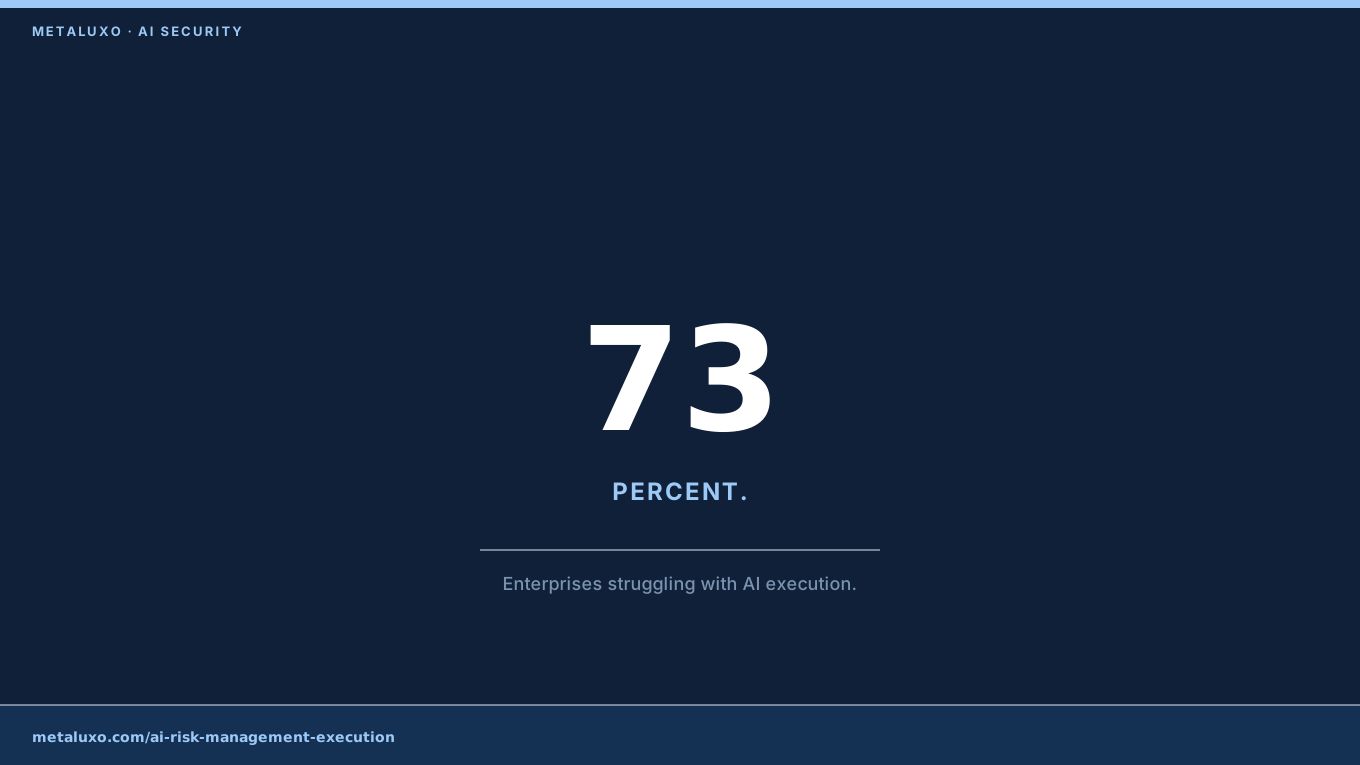
Two years ago the board question was “should we use AI?” Now 73% of enterprises say the problem is execution: teams use AI tools nobody approved, feed them data nobody classified, and ship outputs nobody reviewed. Adoption happened. Governance did not.
Which Three Failure Modes Repeat Everywhere?
- Shadow AI. Personal accounts, unvetted extensions, API keys expensed quietly. Security finds out during the incident, not before.
- Data leakage. Customer PII in prompts, source code in context windows, board decks uploaded to summarise. Each one a GDPR event.
- Unreviewed outputs. AI-generated code merged without review, AI-drafted customer comms sent as-is, AI forecasts treated as forecasts. Hallucination becomes operations.
Every one of these is an execution failure, not a technology failure.
What Are the Five Parts of the Framework?
- Inventory. Quarterly survey: which tools, which teams, which data. No inventory, no governance.
- Data rules. Prohibited inputs documented — PII, source for critical systems, secrets, strategic documents.
- Access control. SSO-gated approved tools, allow-listed domains, quarterly access reviews.
- Output review. A named human accountable for every AI-generated artifact that reaches customers or production.
- Documentation. Risk classification per the EU AI Act, data governance notes, human-oversight procedures — the file regulators ask for first.
How Does the EU AI Act Change This?
Articles 9 and 15 plus the high-risk use-case annexe turn this framework from good practice into legal obligation. Hiring tools, credit scoring, educational assessment — if your systems touch these, you need classification, disclosure, and documentation. Enterprise customers will demand proof from their vendors long before regulators knock.
What I Tell My vCISO Clients
“AI risk is not theoretical — it is operational. Start with inventory, not governance.”
Every assessment finds the same thing: the policy was written for approved tools while the company runs on unapproved ones. The fix is a four-hour shadow AI audit — survey, network check, identity log review — then controls sized to what you actually found.
Bottom Line
The execution gap closes with process, not platforms. If you cannot list every AI tool in use today, book a shadow AI audit — we will inventory your usage in four hours and size the controls to match.
Common questions
What is the AI execution gap?
The distance between approving AI tools and actually governing them — 73% of enterprises struggle with shadow usage, data leakage, and unreviewed outputs.
What is shadow AI?
AI tools employees use without IT approval or oversight — personal ChatGPT accounts, unvetted browser extensions, API keys in personal projects.
What does the EU AI Act require?
Risk classification of AI systems, transparency disclosures for AI interactions, technical documentation for high-risk systems, and human oversight procedures.