The Short Version
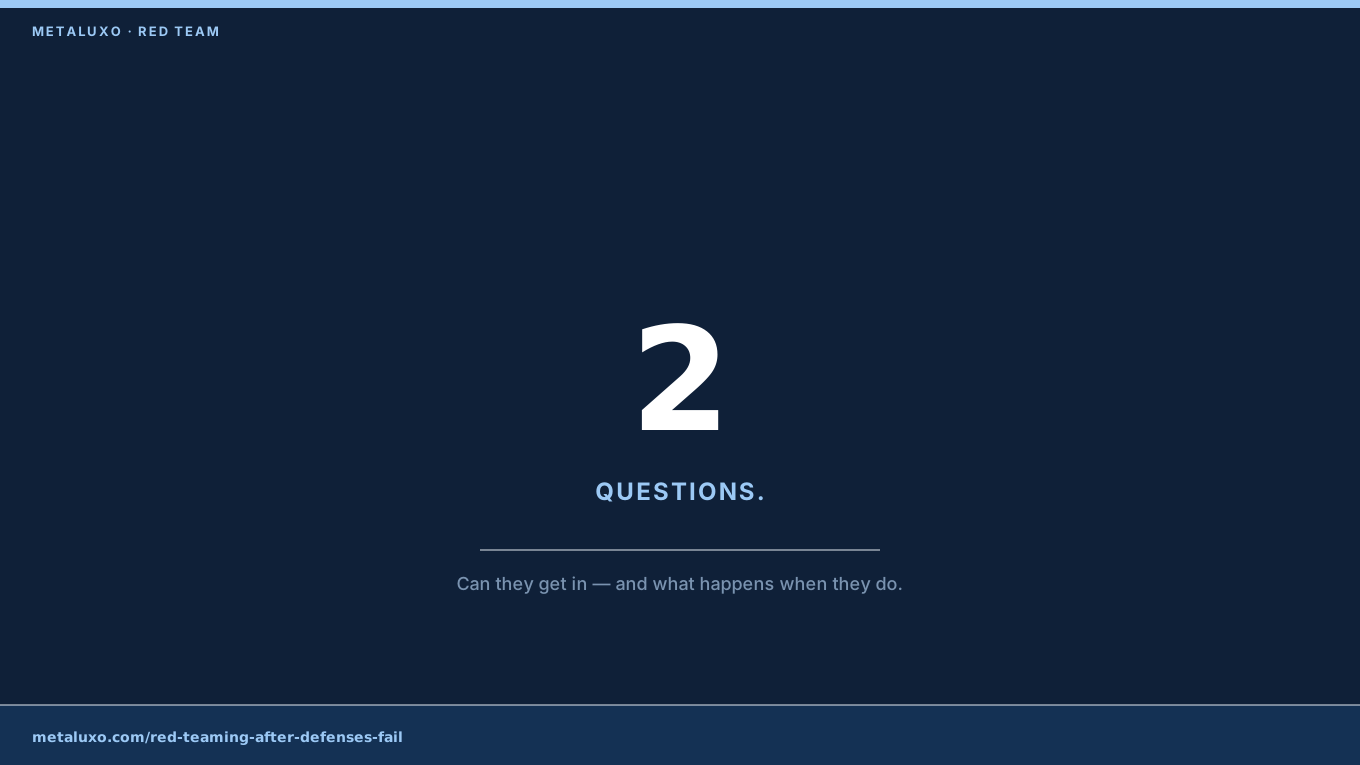
Traditional red teaming answers one question: can attackers get in? Assume the answer is yes — phishing, zero-days, and vendor compromise guarantee it eventually. Red teaming 2.0 asks the harder question: what happens after they are inside? Detection speed, lateral-movement resistance, containment. That is where breaches are won or lost.
What Changed in Red Teaming?
Methodologies like breach simulation start with the attacker already holding a foothold — a phished workstation, a leaked VPN credential — and measure everything after. Time to detection. Systems reachable from the foothold. Data exfiltrated before containment. The output is not a pass or fail on the perimeter; it is a map of your interior.
Why Do Failure Scenarios Matter More?
Because every layer fails eventually, and untested layers fail catastrophically. An untested backup restores nothing. An untested detection rule alerts nobody. An untested runbook gets read at 2 AM by someone seeing it for the first time. Testing the failure mode converts each layer from a hope into a control.
How Do I Run Failure-Scenario Testing?
- Pick one scenario. Ransomware via phishing, cloud-key leak, vendor remote-access abuse. One at a time.
- Define success metrics. Detection within one hour, lateral movement blocked at segment boundary, backups restored within RTO.
- Run it live. Tabletop first, then technical simulation against production-like systems.
- Document findings. What failed, why, who owns the fix, by when. The remediation log is the deliverable auditors want.
Start quarterly. Mature teams run monthly.
What I Tell My vCISO Clients
“Defense in depth only works if you have tested each layer’s failure mode.”
Every tabletop I run finds the same three gaps: nobody knows who declares an incident, backups have never been restore-tested, and the runbook references people who left. Fix those before buying anything.
Bottom Line
Stop asking whether attackers get in and start measuring what they can do once inside. If your team has never run a breach simulation, inquire about a workshop — one afternoon, one scenario, a remediation list you can actually execute.
Common questions
What is red teaming 2.0?
Breach simulation that starts after initial compromise — testing detection, lateral-movement resistance, and containment instead of only testing perimeter defenses.
How does it differ from traditional red teaming?
Traditional asks can attackers get in; modern asks what attackers can reach, how fast you detect them, and whether containment holds when they do.
What does NIS2 require for testing?
NIS2 Article 14 expects incident response capabilities including testing — failure-scenario exercises with documented findings and remediation.