The Short Version
Most SMBs have no formal vendor risk process. Vendors get approved by whoever needs the tool, contracts get signed without security terms, and nobody reviews anything afterwards. Then a breach happens through a vendor and the lawyers ask for the risk file — which does not exist.
You do not need GRC software. You need a two-hour framework: classify, score, contract, review.
How Do I Classify Vendors in Four Tiers?
- Tier 1 — Critical. Touches customer data, payments, or production. Full scorecard, annual review, security addendum mandatory.
- Tier 2 — Important. Internal systems with sensitive data (HR, finance tools). Short scorecard, annual review.
- Tier 3 — Standard. Productivity tools with limited data. Accept vendor SOC 2 or security page at face value, review every two years.
- Tier 4 — Negligible. No data access, no integration. No review needed — but keep them on the inventory.
Start with everything in Tier 1 and downgrade. It forces justification instead of assumptions.
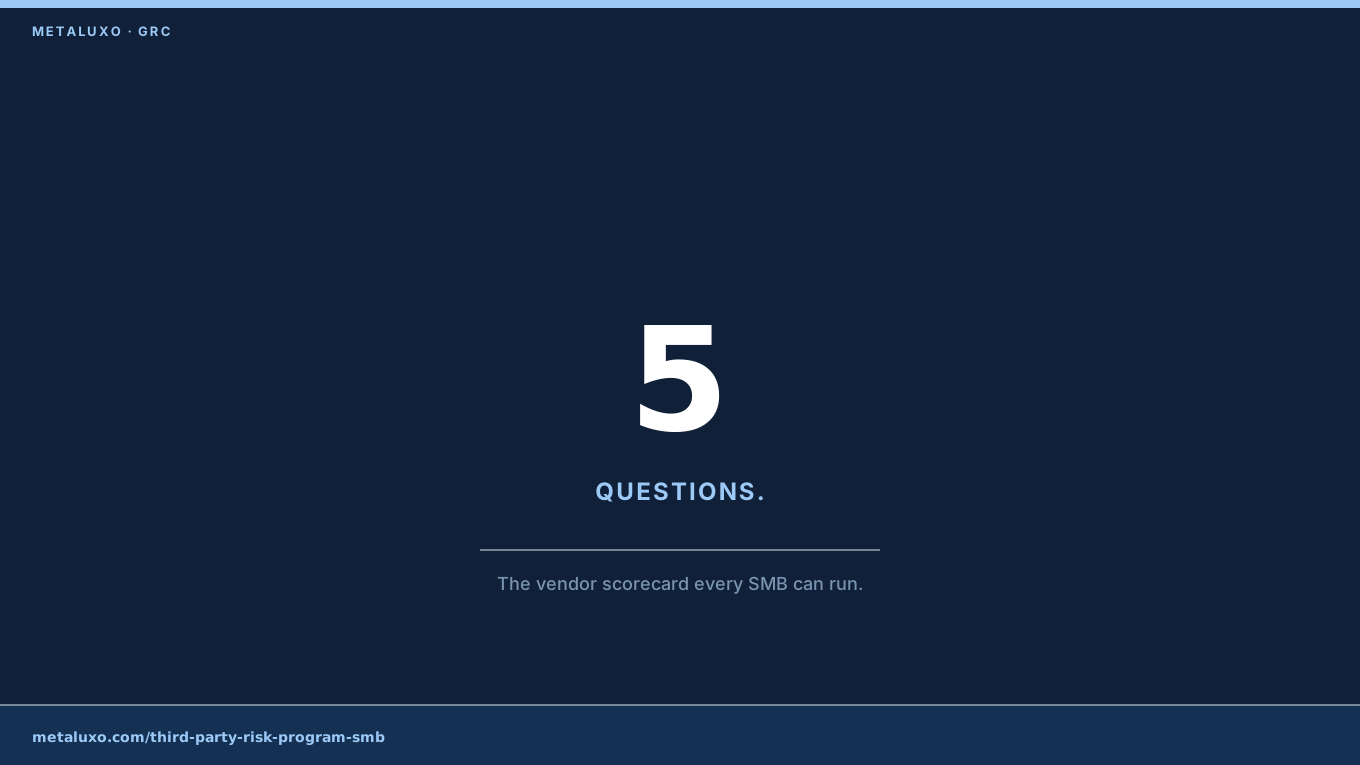
What Five Questions Go on the Scorecard?
- Where is our data stored and processed? Country-level answer required — GDPR Chapter V transfers depend on it.
- Who else can access it? Sub-processors must be named, not “our cloud provider.”
- What happens in a breach? Notification SLA (demand 24 hours), and what they send you.
- Show me evidence. SOC 2, ISO 27001, or a recent penetration test — dated within 12 months.
- How do we leave? Data export format, retention after termination, deletion confirmation.
Five questions, one page per vendor, stored where the next person can find it.
What Contract Terms Actually Matter?
- Breach notification within 24 hours — so you can meet your own 72-hour GDPR clock.
- Sub-processor change notice with opt-out — acquisitions add sub-processors silently; your contract should not allow that.
- Right to audit or equivalent evidence — annual reports, not trust.
- Data return and deletion on exit — with written confirmation.
A lawyer reviews the addendum once. You reuse it for every vendor.
How Often Do I Review?
Tier 1 and 2 annually, Tier 3 every two years, plus ad-hoc reviews on breach news, acquisitions, or scope changes. Each review is 30 minutes: re-run the scorecard, confirm the evidence is current, note the decision. Document it — the review log is what auditors and insurers ask for.
What I Tell My vCISO Clients
“Every vendor contract should include a security addendum. Two hours to draft, years of protection.”
The first session always surfaces the same gaps: no inventory, shared credentials with vendors, contracts with zero security terms. Fix those three and you are ahead of most companies your size.
Bottom Line
Vendor risk is paperwork that pays for itself the day something goes wrong. If your vendor approvals live in email threads, book a review — we will build the scorecard and the addendum with you in one session.
Common questions
What is a third-party risk program?
A documented process for classifying vendors by risk, assessing their security posture, setting contract terms, and reviewing them on a fixed cadence.
Do I need GRC software?
No. A spreadsheet, a five-question scorecard, and a one-page contract addendum cover everything an SMB under 200 people needs to start.
Which regulations require vendor risk management?
GDPR Article 28 for processors and sub-processors, and NIS2 Article 21 for supply chain security in covered entities.