The Short Version
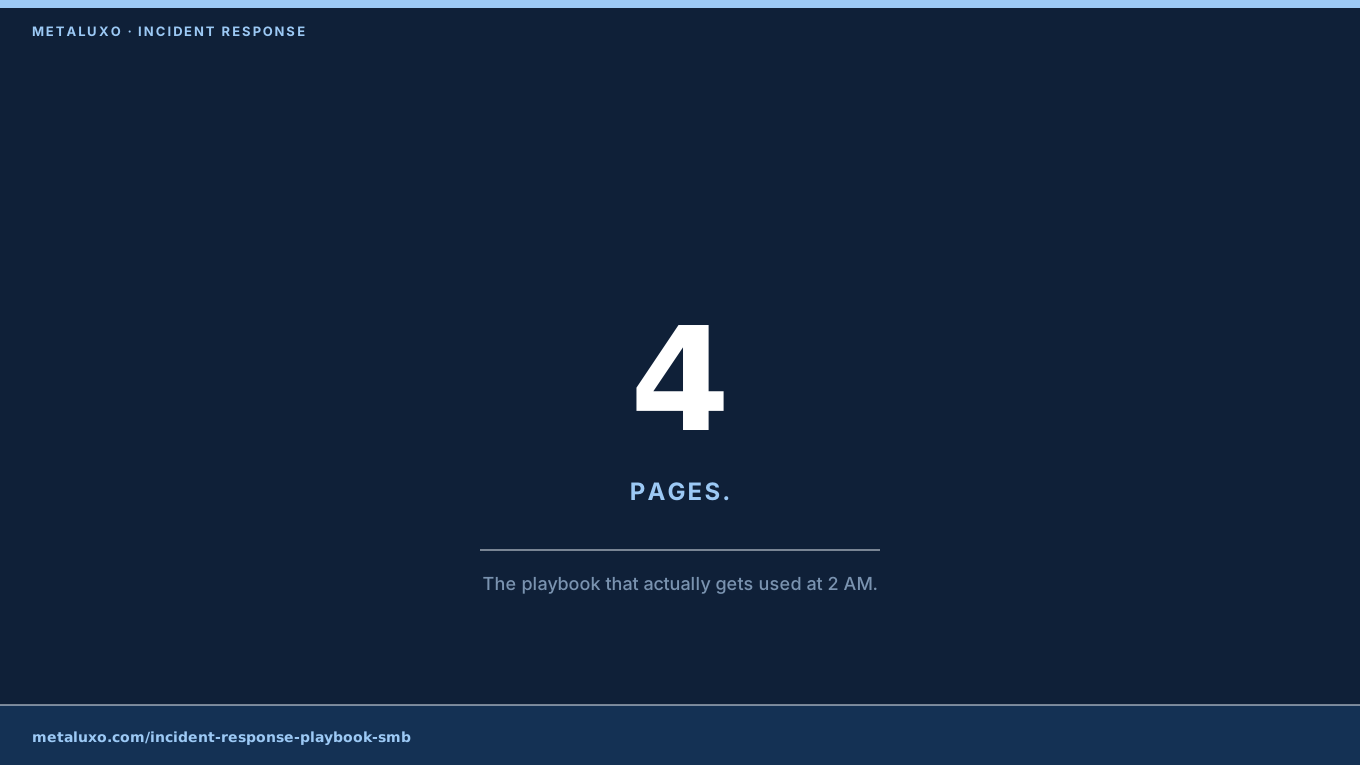
Most incident response plans are twenty-page PDFs nobody has opened. At 2 AM during a real breach, nobody reads twenty pages. This framework produces a four-page playbook in 90 minutes — roles, timelines, templates — that a five-person team can actually execute.
How Does NIST CSF Fit a Five-Person Team?
- Identify. One-page asset inventory: crown-jewel systems, data locations, vendor contacts.
- Protect. MFA everywhere, tested backups, patched edge. Already your baseline.
- Detect. Who watches which alert, and what counts as “declare an incident.”
- Respond. Page one of the playbook: contain, preserve evidence, notify.
- Recover. Page two: restore order, verify integrity, resume service.
Five functions, five owners — some people own two.
What Goes on the Four Pages?
- Declaration and roles. Who can declare an incident, incident lead, comms lead, technical lead, decision-maker. Phone numbers, not email.
- First-hour checklist. Isolate affected systems, preserve logs, photograph ransom notes, do not pay or wipe anything yet.
- Notification timeline. Hour 0–4: internal and counsel. Hour 4–24: NIS2 early warning if in scope. Hour 24–72: GDPR supervisory notification with nature, categories, consequences, measures.
- Communication templates. Customer notice draft, regulator notice draft, internal update draft — fill-in-the-blank, pre-approved by counsel.
Who Does What at 2 AM?
Named humans, not functions. The incident lead runs the clock. The technical lead contains. The comms lead drafts. The decision-maker approves payment, shutdown, and disclosure calls. Write names and deputies. Update it when people leave — stale names are the most common tabletop finding.
How Do I Know It Works?
Test twice a year: one tabletop (talk through a scenario in 90 minutes), one technical (actually restore a backup, actually revoke and reissue credentials). Log findings, assign fixes, retest. The remediation log is what insurers and auditors ask for — not the playbook itself.
Bottom Line
An unread plan is not a plan. If your incident response documentation is longer than four pages or older than your newest hire, book a review — we will build the playbook with you in 90 minutes and test it the same week.
Common questions
What is an incident response playbook?
A short, role-assigned document covering detection, containment, notification, and recovery steps — written for a stressed 2 AM reader, not an auditor.
How does NIST CSF map to a small team?
Identify and Protect become asset inventory plus MFA and backups; Detect is alert triage; Respond and Recover are the playbook's four pages with named owners.
What are the GDPR and NIS2 timelines?
GDPR Article 33 requires supervisory-authority notification within 72 hours of awareness; NIS2 adds 24-hour early warning for covered entities.