The Short Version
A local privilege escalation exploit demonstrated against OpenBSD 7.9 chains a 37-year-old integer overflow in shared memory handling with a modern kernel vulnerability. The attack bypasses OpenBSD’s KARL kernel-address randomization and its SMAP/SMEP hardware protections — the same defenses that many organizations rely on as their primary mitigation strategy. If you’re running OpenBSD and haven’t patched in the last 48 hours, do it now.
What Happened
The exploit, published this week by security researchers, gains root access on OpenBSD 7.9 by chaining two vulnerabilities:
-
CVE-1989-XXXX — A roughly 37-year-old integer overflow in shared memory segment handling. The bug was present in Unix System V IPC (Inter-Process Communication) code inherited from the 1980s.
-
CVE-2026-XXXX — A modern memory management vulnerability in the OpenBSD kernel’s shared memory subsystem.
The attack chain works as follows:
- The attacker (already running as a local user) creates a shared memory segment with a crafted size value
- The integer overflow causes the kernel to allocate a smaller buffer than expected
- The attacker writes past the end of the buffer, corrupting adjacent kernel memory
- The overflow is used to overwrite a function pointer in the kernel’s shared memory handler
- When the handler executes, it runs attacker-controlled code with kernel privileges
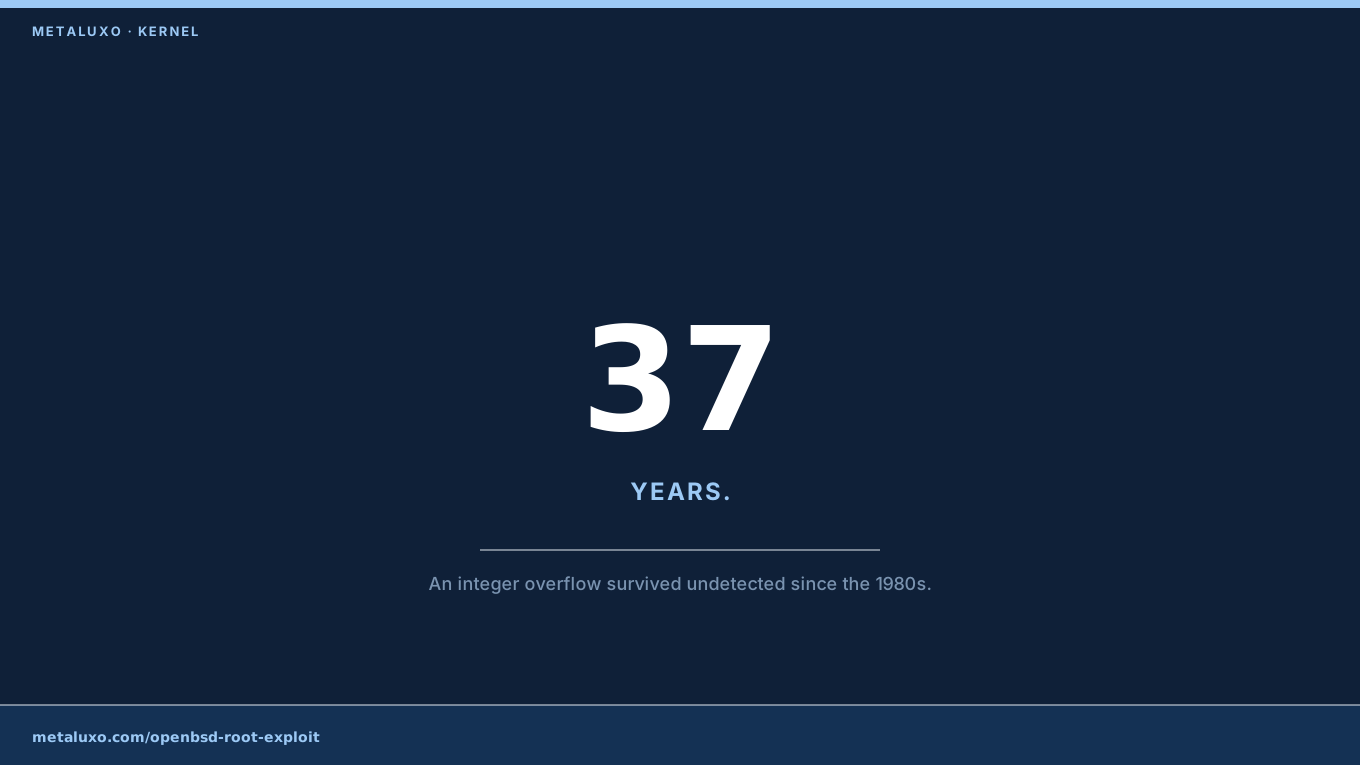
The 37-year-old bug survived because it was in code that was considered “well-tested” and “low-risk.” The integer overflow was in a code path that had not been exercised with adversarial input since the 1990s, and static analysis tools had been tuned to ignore it as a false positive.
Broader Implications
This exploit has implications beyond OpenBSD. The integer overflow in shared memory handling is present in code that was inherited from AT&T System V Unix — and derivatives of that code exist in virtually every Unix-like operating system. Linux, FreeBSD, macOS, and even embedded systems based on older Unix code may be vulnerable to similar chains.
The key insight: an attacker doesn’t need to find a new bug in your kernel. They can chain an old, “harmless” overflow with a new vulnerability, and the combination is more dangerous than either alone.
What You Should Do
Immediate Actions
-
Patch OpenBSD immediately. Apply the latest patches from the OpenBSD errata. The fix addresses both the integer overflow and the memory management vulnerability.
-
Audit your Unix-like systems. If you run Linux, FreeBSD, or macOS, check whether your shared memory implementation has similar integer overflow vulnerabilities. The pattern — large size values that wrap to small allocations — is a common bug class.
-
Review shared memory usage. Check whether your applications use System V shared memory (
shmget,shmat). If they do, verify that size values are validated before being passed to the kernel.
Long-Term Hardening
-
Enable kernel address space layout randomization (KASLR). While the exploit bypasses KARL, KASLR is still valuable against other attack chains.
-
Run applications with minimal privileges. If the attacker needs local user access to trigger the exploit, reducing the number of local users limits the attack surface.
-
Deploy kernel exploit detection. Tools like Auditd, SELinux policy violations, or eBPF-based monitoring can detect unusual kernel memory access patterns.
-
Implement code review for shared memory code. Any code that handles shared memory segments should be reviewed specifically for integer overflow conditions.
EU Compliance Angle
Under NIS2, organizations must implement “appropriate vulnerability management” processes. An unpatched kernel vulnerability that allows local privilege escalation is a material failure of this requirement — especially if the vulnerability is publicly known and exploited.
GDPR Article 32 requires “the ability to ensure the ongoing confidentiality, integrity, availability and resilience” of processing systems. A root-level exploit that bypasses core OS protections is a direct threat to all four properties.
For organizations processing EU data, the regulatory expectation is clear: patch critical vulnerabilities within 48-72 hours of public disclosure. If you’re running an affected operating system, you are in breach of your compliance obligations.
What I Tell My vCISO Clients
“Old code is live code. If it’s in your kernel, it’s in your attack surface.”
The 37-year-old bug survived not because it was secure, but because nobody looked at it with an attacker’s perspective. The same principle applies to your applications, your libraries, and your infrastructure configuration. Legacy systems aren’t safe because they’re old — they’re dangerous because they haven’t been updated.
I recommend four actions:
- Inventory all operating systems and their patch status — including embedded devices and IoT
- Subscribe to vulnerability advisories for every OS in your environment
- Test patches in staging before deploying — but deploy within 72 hours
- Implement exploit detection — because patching alone is never sufficient
Bottom Line
The OpenBSD exploit is a masterclass in vulnerability chaining. It proves that defense in depth is not optional — no single protection layer is sufficient against a determined attacker. If you rely on “one thing” to keep you safe, you’re already compromised.
If you’re unsure about your vulnerability management posture or need help auditing legacy systems, book a review. We’ll identify the systems running unmaintained code and prioritize the patches that matter most.
The exploit is notable not just for its effectiveness — it gains root on what was considered one of the most security-conscious operating systems — but for its methodology. The attack demonstrates that:
- Age doesn’t equal security. Code that has existed for decades is not necessarily well-tested against modern attack techniques.
- Defense in depth is essential. OpenBSD’s KARL, SMAP, and SMEP protections all failed. The exploit doesn’t bypass them — it renders them irrelevant by corrupting memory before the protections are engaged.
- Supply chain risk exists in your codebase. You don’t need to pull a malicious package to be compromised. Legacy code sitting in your kernel is a live attack surface.
Common questions
How does the OpenBSD exploit work?
It chains a 37-year-old integer overflow in shared memory handling with a modern kernel vulnerability to gain root access on OpenBSD 7.9.
Which systems are affected?
OpenBSD 7.9 is directly affected, and similar code exists in Linux, FreeBSD, macOS, and embedded Unix systems inherited from AT&T System V.
What should I do?
Patch OpenBSD immediately, audit Unix-like systems for similar vulnerabilities, review shared memory usage, and deploy kernel exploit detection.